
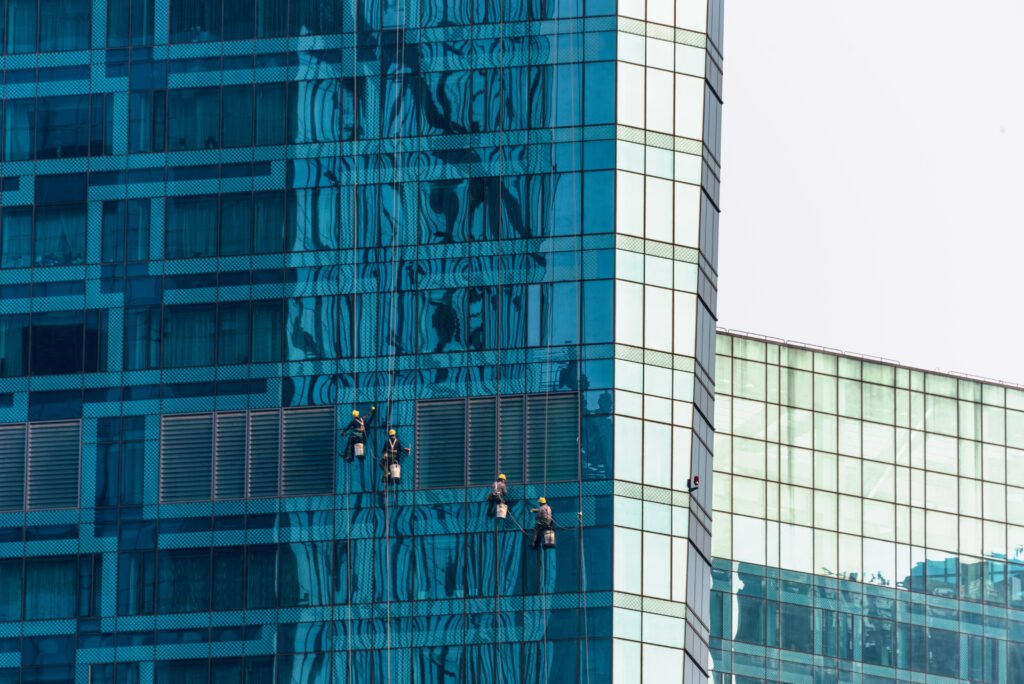
If you have driven through Gurgaon’s Golf Course Road or Noida’s Sector 62 lately, you have probably noticed it too. Some office towers still look crisp even after fifteen years. Some are only just a decade old and already show soot streaks on the glass, paint flaking at the entrance and window seals that have become fragile from the sun. It’s almost always about whether someone invested in facade restoration before the damage was noticeable from the streets.
For property owners and facility managers across Delhi NCR, the facade represents more than the exterior surface of a building. It’s the first thing a tenant, investor or job candidate sees and more frequently it is linked closely to how the building performs financially. This guide explains what facade restoration involves, why it is so important in this region particularly and how it should be thought about as an investment rather than a maintenance expense.
Quick Answer: What Is Commercial Building Facade Restoration?
Facade restoration is the process of repairing, strengthening and refreshing a building’s exterior, including its cladding, plaster, stonework, glazing, sealants and finishes, without demolishing or completely replacing the structure. It is a unique type of work and it’s worth separating from the three things people commonly associate it with:
- Routine painting only refreshes the surface. It does not deal with cracked plaster, failed waterproofing, corroded reinforcement or damned sealant joints below.
- Complete redevelopment means tearing down and rebuilding, which is a much larger financial and regulatory challenge and is only logical when the building becomes irreparable.
- Interior renovation focuses on the inside of the building, including fit outs, flooring and partitions without affecting the exterior envelope at all.
Restoration falls in the middle. It deals with the building’s envelope directly, addressing the specific issues (cracks, leaks, corrosion, failed glazing) while maintaining the structure and the original character of the building.
Why Older Office Buildings in Delhi NCR Need Facade Upgrades
Buildings in this region age differently than buildings elsewhere and there are specific reasons for that.
Pollution and airborne particulate matter settle on exterior surfaces year round, and over time this grime isn’t just cosmetic. It can accelerate the breakdown of paint films, sealants, and certain stone finishes, particularly on buildings facing busy arterial roads.
Extreme heat exposure during Delhi NCR summers, where surface temperatures on south and west-facing facades can climb well beyond ambient air temperature, puts real stress on sealants, glazing gaskets, and expansion joints, causing them to harden and crack faster than they would in milder climates.
Monsoon driven water seepage is probably the single biggest culprit behind facade deterioration in this region. Once a sealant joint fails or plaster develops hairline cracks, monsoon rain finds its way in and what starts as a small stain can eventually reach structural reinforcement.
Dated entrances and tenant expectations matter too. A decade ago, a functional lobby and a working lift were enough. Today, especially with Grade A+ office demand rising sharply across Gurugram, Noida, and Delhi’s Aerocity, tenants are comparing buildings side by side, and an outdated entrance genuinely costs owners in leasing conversations.
Common Signs a Commercial Building Needs Facade Restoration
Most facade problems give warning signs well before they become expensive. Keep an eye out for:
- Visible cracks in plaster, stone cladding, or concrete elements, especially around window frames and expansion joints
- Damaged or delaminating cladding panels, or panels that sound hollow when tapped
- Sealants that have hardened, shrunk, or pulled away from joints, often visible as thin gaps around windows
- Staining or discolouration, particularly dark streaks below window sills or parapets, which usually indicate water tracking
- Water ingress inside the building, damp patches on interior walls near the exterior, or peeling interior paint on outer walls
- Outdated single or double glazing that no longer matches current thermal or acoustic expectations
- Entrances and porticos that look tired compared to newer buildings nearby, chipped stone, faded signage areas, worn flooring at the threshold
If you’re noticing two or more of these, it’s usually time to bring in a facade consultant for a proper assessment rather than waiting for the next monsoon to make the decision for you.
How Often Should Commercial Facades Be Inspected in Delhi NCR?
A sensible routine is to carry out a visual check before and after the monsoon, with a more detailed professional assessment every three to five years. Buildings alongside bustling roads, properties featuring extensive glass surfaces and facades that have a history of leaks may need more careful examination. An additional inspection is also wiser after severe weather or whenever fresh cracks, stains or damp areas appear.
What Hub & Oak Often Finds During Facade Assessments
Across older Delhi NCR office buildings we assess, failed sealant joints around glazing are often mistaken for a broader waterproofing problem. The damp patch may appear on an internal wall or ceiling, some distance from the actual entry point. That is why treating the visible stain alone rarely works. The joint, frame, sill, parapet and nearby cracks all need to be checked together.
Occupied buildings bring a different challenge: the repair plan has to work around people, entrances and daily business. We generally divide the facade elevation by elevation, and sometimes bay by bay around busy access points. This keeps scaffolding and noisy work contained, makes responsibility easier to track and prevents the whole building from feeling like a construction site at once.
How Facade Restoration Improves Commercial Property Appeal
The exterior of a building performs a great deal of silent work. It’s the first impression for a potential tenant walking up from the parking lot, influencing how a client views a company’s trustworthiness and prioritiess whether the building management takes maintenance seriously.
Tenants renting space for their brand identity value this more than property owners expect. A well lit, polished entrance and a clean, well maintained facade suggest that the rest of the building, including HVAC, lifts, fire safety, common areas is in equally good condition. A streaked or patchy exterior prompts the exact opposite question in a tenant’s mind, even if it doesn’t completely reflect a building’s actual state.
Facade Restoration and Energy Efficiency
Facade restoration and energy efficiency are linked together. The quality of glazing, shading devices, insulation behind cladding and how much direct sunlight a building’s glass absorbs all affect cooling loads, which is a major expense for any commercial building running air conditioning through Delhi NCR’s long hot months.
Restoration projects involving glazing or shading features present a chance to reconsider these choices, higher performing glass, external shading fins, improved sealing around frames, all of which decrease solar heat gain and can lower HVAC energy consumption.
It is important to mention India’s Energy Conservation Building Code (ECBC) here, developed by the Bureau of Energy Efficiency under the Ministry of Power. The code sets minimum energy performance standards for buildings or building complexes with a connected load of 100 kW or greater, or a contract demand of 120 kVA or more, designated for commercial use.
Buildings that meet ECBC compliant design standards can experience meaningful reductions in energy consumption compared to traditionally constructed buildings. However, not all current commercial buildings are automatically subject to ECBC’s mandatory compliance requirements applicability depends on the building’s load profile, its condition and whether that state has notified ECBC as mandatory. It’s a code worth discussing with a qualified consultant during a facade upgrade, rather than presuming it either applies or does not apply to your specific building.
Materials and Methods Used in Commercial Facade Upgrades
The appropriate choice depends entirely on current structure of the building, its exposure, budget and the specific problems being addressed. Generally, restoration efforts in Delhi NCR are based on:
- Glass and glazing systems, including basic replacement glazing to advanced low E or double glazed units for improved thermal control
- Metal composite panels and aluminium cladding, are favoured for their light weight and uniform appearance, the connection details between the panels and structure are crucial for long term durability.
- Natural stone and reconstituted stone finishes, commonly found in older institutional and corporate buildings, which require cleaning, repointing and specific replacements instead of complete removal.
- Protective and waterproof coating, applied on plaster or concrete to withstand pollution staining and water penetration.
- External shading systems, louvers, fins and overhangs that reduce direct heat gain on exposed facades.
- Sealant and gasket replacement, the least noticeable but most consequential part of a restoration scope, since failed sealants are behind the majority of water intrusion issues.
Each of these options involves trade offs around durability, ongoing maintenance and fire safety, especially regarding cladding and insulation materials, as fire performance has increasingly become a key focus for commercial buildings in recent times. None of this should be concluded before a thorough site evaluation. A material that performs well on one building’s orientation and structure may be unsuitable for another.
Can Facade Restoration Stop Water Seepage?
Yes, when rainwater is entering through failed sealant joints, cracked plaster, window perimeters, parapets or gaps in the cladding system. The important part is finding the actual route taken by the water before repairs begin. Simply coating the damp area may hide the symptom for a while, but it will not solve seepage caused by a failed joint or poorly detailed junction.
Facade Restoration vs. Facade Replacement vs. Complete Redevelopment
These three approaches address different problems and considering them on a spectrum is beneficial.
Facade restoration is justifiable when the foundational structure is stable and the problems are specific like cracked plaster, failed sealants, aging glazing and staining. It’s the least intrusive alternative, tenants can use the space and timelines run from a few months to under a year depending on building size.
Facade replacement is the removal and reconstruction of large sections of the whole exterior layer, selected when the current cladding system has failed or is truly outdated. It is more expensive than restoration and takes more time but still maintains the building’s core structure.
Complete redevelopment means tearing down and reconstructing entirely from the foundation. This is reserved for buildings where the structural condition itself is compromised, rather than just the facade or where the land’s value and zoning allow for a much larger or different construction than what is presently there. It’s the option that is most disruptive, the costliest and has the longest timeline.
For the majority of old but structurally sound office buildings across Delhi NCR, restoration or selective replacement addresses the real issue without the expense or the disruption of entire redevelopment.
When Should a Facade Be Restored Rather Than Replaced?
Restoration usually makes sense when the main facade system is still secure and the damage is limited to repairable areas such as sealants, plaster, coatings, isolated cladding panels or sections of glazing. Replacement becomes the safer choice when failures are widespread, fixings are unreliable, the system no longer meets performance or fire-safety needs, or repeated repairs have stopped delivering a durable result.
How Long Does Facade Restoration Take?
A small, straightforward commercial facade may take a few weeks, while a larger occupied office building can take several months. Height, access, repair depth, glazing work, approvals and weather all affect the programme. Phased work takes longer than an empty-site project, but it allows the building to remain operational. A dependable timeline can only be prepared after the condition assessment and access plan are complete.
Can Facade Restoration Increase Office Rental Value?
Exterior improvements can build a stronger rental positioning but it’s important to be truthful about their effectiveness instead of promising instant profits.
A refreshed facade can create a better first impression and can justify a slight premium but the real rental benefits happen when facade work is part of a wider upgrade including a renovated lobby, better common areas, updated lifts and improved building services.
This pattern shows up clearly in current Delhi NCR market data. JLL’s research on the region’s office market indicates that premium Grade A+ buildings, generally those with modern or recently renovated amenities, achieved about a 32% rental premium over standard Grade A properties in 2025 and secured 65% of the overall leasing demand that year, up sharply from 45% just three years earlier.
That gap highlights tenants actively paying more for buildings that look and function like premium assets. Facade restoration is a prominent aspect of elevating a building from the ‘functional but worn’ classification to the premium bracket but it is most effective when integrated into a comprehensive renovation rather than an isolated cosmetic fix.
Combining Facade Renovation With Office Interiors and Common Area Upgrades
This is precisely where the worth compounds. A restored facade brings people up to the entrance but the experience inside equally matters as well. We have seen how disjointed a beautifully renovated exterior can feel when it leads to an outdated lobby or reception area that has not been updated in ten years.
Integrated upgrades, treating the facade, entrance, lobby, reception, meeting spaces and office fit out as a single unified project, usually yield a much more cohesive result than approaching them individually over multiple years. It is more efficient in terms of logistics. Coordinating scaffolding, material deliveries and contractor schedules in a single instance, rather than disrupting the same building repeatedly over the years saves money and maintains tenant goodwill. If you are planning for facade renovation, it is important that you evaluate whether your lobby, common areas and office interiors are due for the same conversation.
What Is Included in a Facade Condition Assessment?
A useful assessment goes beyond taking photographs from the ground. It should map cracks, loose finishes, staining, failed sealants, glazing defects and likely water entry points. Depending on the building, it may also include close up access, tapping or adhesion tests, moisture checks, thermal imaging and a review of drawings or earlier repair records. The final report should prioritise risks and turn the findings into a clear repair scope and BOQ.
What Determines the Cost of Facade Restoration?
Costs differ between projects and there’s no single number that applies to every building. The main factors that influence the budget are:
- Height and access specifications for buildings: higher buildings require additional scaffolding, hydraulic lifts or rope access, which increase project expense.
- Material condition: a building with early stage plaster cracking costs far less to restore than one where water has already affected the reinforcement steel
- Scope of repairs: The range of repairs includes cosmetic cleaning and repainting at the lower end and structural concrete repairs, rebar treatment and cladding replacement at the upper end.
- Glazing Scope: Full window and glazing replacement adds substantially more than sealant and gasket work alone.
- Waterproofing requirements: comprehensive waterproofing at joints, parapets, and terraces is often bundled with facade work and adds to the overall figure.
- Safety arrangements: scaffolding, safety netting, and site safety compliance, particularly important when work happens above occupied public areas or busy roads.
- Approvals and documentation: depending on the building’s location and height, certain structural or fire-safety approvals may be required before work begins.
- Working around occupied offices: phased work that allows tenants to continue operating typically costs more and takes longer than working on a vacant building, since it requires careful sequencing and noise or dust management.
Due to this range, the sole dependable method to obtain an exact figure is through a thorough site visit and detailed bill quantities. Anyone providing a specific number without examining the building is guessing.
What Is the Best Time of Year for Facade Restoration in Delhi NCR?
For most exterior repairs, the most workable windows are after the monsoon and before peak summer, provided the surfaces are dry and temperatures suit the specified products. Waterproofing, coatings and sealants need suitable curing conditions, so heavy rain, intense heat and very cold spells can interrupt the sequence. Assessment and tendering can begin earlier, allowing site work to start when the weather window opens.
How to Choose the Right Commercial Renovation Partner
A facade restoration project involves structural repairs, waterproofing, glazing, electrical routing near the exterior and frequent fire safety compliance, making the choice of partner as crucial as the choice of materials. A few aspects to consider before finalising your agreement:
- A proper site assessment first: Anyone willing to price a project without inspecting the building and testing the existing condition is overlooking an important step.
- Clarity on scope before work begins: It should be clearly recorded in a bill of quantities (BOQ) that highlights materials, quantities and workmanship standards, so there’s no ambiguity later about what was actually incorporated.
- Access to specialist consultants: Rather than one general contractor go for structural engineers for RCC repair, facade engineers for cladding and glazing systems and waterproofing specialists
- Realistic execution planning: Especially regarding stages if the building stays occupied and a sequence that considers monsoon timing, as specific waterproofing and exterior tasks should be minimised during intense rainfall.
- Coordination across trades: Facade work overlaps with electrical, plumbing and interior teams, a partner who can handle the handoff properly saves a lot of friction on site.
Frequently Asked Questions
What is facade restoration in a commercial building?
It’s the process of repairing and refreshing a building’s exterior surfaces, cladding, plaster, glazing, and sealants to fix issues like cracking, water seepage, and deteriorated finishes, without demolishing or fully rebuilding the structure.
How is facade restoration different from facade replacement?
Restoration fixes and refreshes the current exterior where the underlying structure is stable. Replacement is about removing and rebuilding large sections or the facade system due to the structural failure of the current cladding or its obsolescence. Replacement costs more and requires more time than restoration.
Can an office building be renovated while occupied?
Yes, but it needs more careful planning sequencing of scaffolding and coordination to reduce the disruption for tenants. Work that generates noise or dust is planned outside business hours or done in phases.
Does facade restoration improve energy efficiency?
It can, particularly when it involves upgrading glazing, adding shading elements or improving sealing around windows and joints. The extent of improvement depends on what’s included in the scope, and whether the building falls under ECBC’s applicability criteria is worth confirming with a qualified consultant.
How much does commercial facade renovation cost in Delhi NCR?
Costs vary widely based on building height, existing condition, and scope, from relatively modest cleaning and minor repair work to significantly higher figures for structural repair and full glazing replacement. A site assessment and detailed BOQ are the only reliable way to get an accurate estimate for a specific building.
Does facade restoration require approvals?
It can, depending on the building’s height, location, and the nature of the work, particularly for structural changes or work affecting fire safety systems. It’s worth confirming requirements with local authorities or a qualified consultant before starting.
Can facade and interior renovation be completed together?
Yes and there are real advantages to doing so. Combining façade work with lobby, common-area, and office interior upgrades in one coordinated project, rather than spreading them across separate timelines, generally reduces overall disruption and gives the building a more cohesive finished result.
Hub & Oak Interiors works with commercial property owners and facility teams across Delhi NCR on facade restoration, common area upgrades, and office interior fit outs, as standalone projects or as one coordinated renovation.